ANGEL PATCHAMANOV
Biography
Already in the first decades of this century Malevich had understood that absolute form and absolute color could only coincide with the end of painting. Abstract art thus matured the limits of the rational, but it also set off the irrational within abstraction. The “signifier” became a sort of “healthy carrier” of that virus of the Self which, over time, determined evolutions, splits and ideological transgressions from the rigor of rationalism and constructivism.
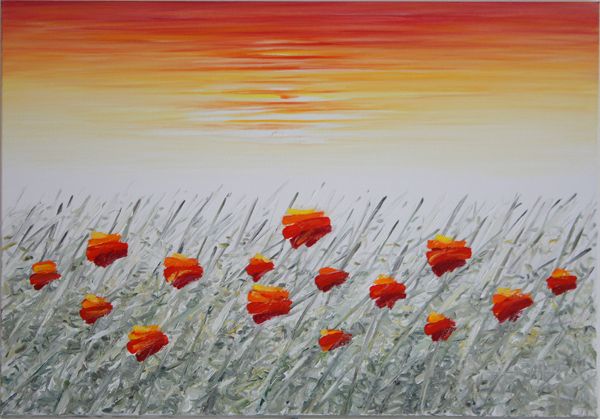
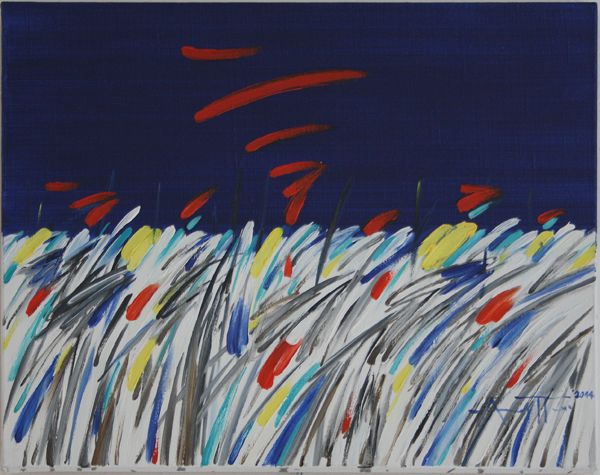
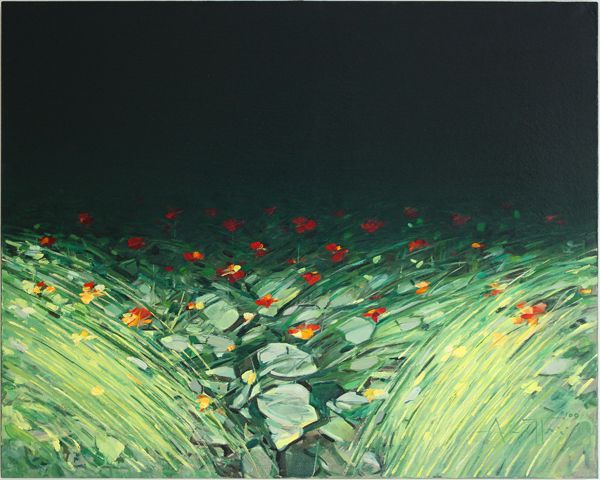
With the painting of Angel Patchamanov we are faced with an example of how the modes of abstraction have been integrated into the complex and autonomous meaning of today’s visual art. Patchamanov is not dominated by the anxiety of conformity, as happens instead with many abstractionists of the new generations, but appears ready to live the flow of existence with flexibility. Indeed, his page offers us a world in constant movement and, consequently, change; where at times a figural image clearly appears, in certain cases anthropomorphic, establishing the prevalence of themes tied to man, to his imagination, to his dreams, in short to his being as essence and existence. Dora Vallier wrote in this regard: “When the question of the subconscious is raised in art, one thinks of surrealism. Certainly because surrealism made direct reference to it, following Freud’s theories to the letter, whereas abstract art, at first, seems resolutely to turn its back on them” (D. Vallier, L’astrattismo, Milan, Garzanti, 1984). As it evolved, abstract art instead, as it were, tore off shreds of the subconscious and offered them to the gaze unelaborated, in the form of a kind of stammering (Wols) or of free-wheeling incursions (Pollock). What Patchamanov offers us is characterized rather by a centripetal dynamic, where everything converges in a single inner vision (“A painting is no longer a construction of colors and lines, but an animal, a night, a man, or all of this together,” declared the artists of the Cobra group). Patchamanov’s painting has a tight rhythm, a barely contained impetuosity, which expresses a vitality still imaginative at its origin, whereby man is bound to all things and to the sense of mystery of nature. In this context the emphasis should be placed on the term “vision”: this inner mirror that reflects a life indistinct in rational terms but densely woven with the motifs of fantasy… Especially in the most recent paintings, the vivid colors and the brushstrokes left in evidence, wearing the pictorial gesture down to exhaustion, are organized to build forms and then systems of forms, ever more defined. It is a slow advance in the measure of the self, in a process of comparison and assimilation, of drawing one thing close to another: a mechanism of progressive choices like the locks of a river, which filter it all the way to the sea.
Such a formulation is accomplished by transposing beyond its own form a light-setting intact in its efficiencies, modulated in decisive hues, and it seems the outlet of energies reborn from visual experience, an answer of expression to the emotion, which results in a singular ability to define those volumes and those images mirrored from within.
Nicola Nuti